In this unique conversation, Kieran McLoughlin, Co-Founder & Managing Partner of VentureWave Capital, sits down with Sir Ronald Cohen, one of the founding fathers of venture capital, impact investing, and social entrepreneurship. As the former chair of the Global Steering Group for Impact Investment, Sir Ronald brings decades of experience and groundbreaking ideas on integrating social impact with financial returns.
A unique feature of the Impact Ireland fund is the Global Advisory Council, which is comprised of our investors, whose mission is to increase awareness of Impact Investing. A key part of our philosophy at VentureWave Capital is to deepen our knowledge of the philosophy and practical implications of Impact Investing.
On 13th October 2021, we were delighted that Sir Ronald Cohen was able to make himself available for a private online briefing with the Global Advisory Council. We were joined by over 30 members of the Council from Europe, the US and Asia.
Sir Ronald Cohen is acknowledged as one of the pioneers and thought leaders of the Impact Investing movement. Sir Ronald speaks about us experiencing an investment revolution that will have equal implications for the Technology and Industrial Revolution.
Enda Kenny, Chairman of the Global Advisory Council and former Taoiseach, opened the discussion. Enda introduced Sir Ronald as the ‘Father’ of Impact Investing and European venture capital.
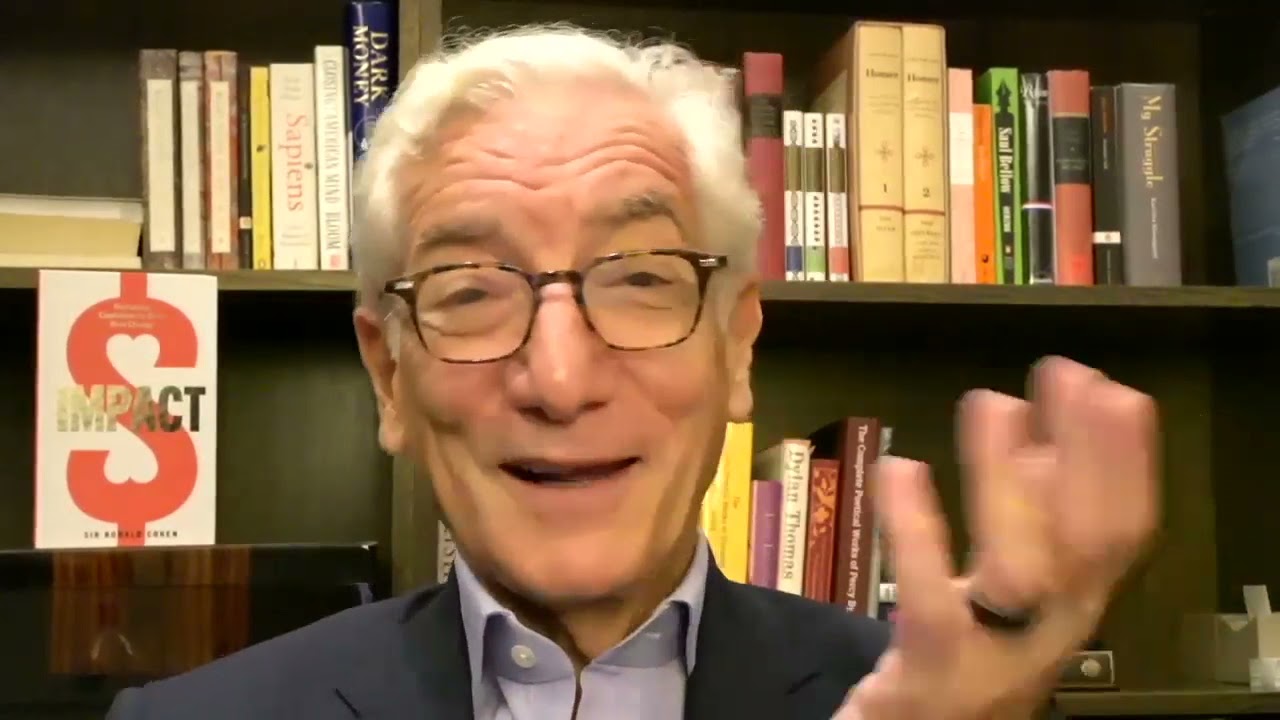

(Image: Sir Ronald Cohen and Kieran McLoughlin)
Kieran McLoughlin, Managing Partner of VentureWave Capital, began the interview with Sir Ronald by asking him to recount his experience of his journey to the UK as an Egyptian refugee at 11. Driven and determined, Sir Ronald described how he assiduously sought to rise to the challenge of becoming top of his class in his new school and gaining a place at Oxford University. He observed that his experience as a refugee was ultimately “one of challenge but also one of fulfilment.”
Sir Ronald co-founded global private equity firm Apax Partners in 1972, at a pivotal time for the venture capital industry. This was felt when he arrived at Harvard in 1967 when it was anticipated that technological advances would revolutionise investing. Sir Ronald believed that under the new be venture capital model, small-scale entrepreneurs would be behind technological development, which shaped his decision to become a venture capitalist.
Broadening vision – From success to significance
Sir Ronald realised that the gap between rich and poor was expanding despite economic growth. He left Apax in 2005, turning his focus to tackling social problems and how they could be solved by investment. Government spending was not achieving its desired objectives, and there was a need for financial innovation to connect the vast investment markets with those who wanted to improve the lives of others.
To this point, Kieran noted Bono’s remark that ‘capitalism is not immoral, it is amoral.’ The market, through its discipline, demand for results, and capacity, can lead to social change.
An Investment Revolution
Sir Ronald set out three main forces acting today to improve the world. The first is a massive change in values among people, who are no longer interested in buying products causing environmental harm. This practice has been noticed by investors, who are channelling $40 trillion in ESG investments to achieve impact and profit.
Secondly, the ongoing powerful leaps in technology are considered more significant than those of the microchip, including Artificial Intelligence, machine learning, augmented reality and computing. These advances enable us to deliver global impact in ways that humans could not have before.
Thirdly, the transparency of Impact standards of companies is now imperative. We can now measure in monetary terms the impact that companies create through their operations, employment and products on the environment. Sir Ronald gave the example of the Harvard Business School Impact Weighted Accounts Initiative to illustrate the monetisation of Impact for companies:
“Taking 3000 companies and measuring environmental impact in dollar terms: 450 companies create more damage in a year than they create profit, and 1000 of these companies create damage equivalent to one quarter or more of their annual profit. Together, they create $4 trillion of damage in a single year. Most importantly, as investors, a correlation has already emerged between companies that pollute more and lower stock market valuations.”
Ensuring regulation stimulates innovation
Sir Ronald explained that the shift to impact transparency has become ‘inevitable.’ Research has shown that Impact data can be price sensitive, bolstered by pressure from the EU, the SEC and IOSCO (the International Organization of Securities Commissions) on regulators to introduce legislation on impact reporting transparency.
Sir Ronald argues that “transparency is not something companies can easily fight today. It is viewed as a human right and an essential element in democracy.”
Sir Ronald has put forward the case for Impact Investing as an investor himself. He puts this down to a reduction in the risk of taxation and regulation, such as increased carbon taxes or regulation of the use of fossil fuels. He also ascribes this to the superior returns generated due to a more efficient investment frontage by optimised risk-return and increased opportunity sets.
Despite his optimism, Sir Ronald observed how a large barricade regarding Impact transparency and integrity remains in the way. He likens this to the period during the 1930s following the Wall Street Crash of 1929 when the Roosevelt administration established Generally Accepted Accounting Principles for all companies irrespective of size and sector. He believes that we are at a similar crossroads today regarding impact transparency. Victory is in sight because Impact data now affects financial markets and company valuations. This will force regulators to step in and provide mandatory Impact accounting transparency across all sectors rather than qualitative reporting.
The event then went into a private session for Questions and Answers with the Council members.
About Sir Ronald Cohen
Sir Ronald Cohen is a pioneering philanthropist, venture capitalist, private equity investor, and social innovator. He is recognized as the father of impact investment and European venture capital and is driving the global Impact Revolution forward. He serves as Chairman of the Global Steering Group for Impact Investment, the Impact-Weighted Accounts Initiative at Harvard Business School, and The Portland Trust. He is a co-founder and former Executive Chairman of Apax Partners Worldwide, a global private equity firm. He is also a co-founder of Social Finance UK, USA, and Israel, co-founder of Bridges Fund Management and former co-founding Chair of Big Society Capital. Oxford and Harvard educated, Ronnie was born in Egypt and left as a refugee at 11 when his family came to the UK. He is now based in Tel Aviv, London and New York. He is the author of IMPACT: Reshaping Capitalism to Drive Real Change, published in 2020 by Penguin Random House and is a Wall Street Journal Best Seller.